
Applications of Otolith Size
Víctor Manuel Tuset & Antoni Lombarte
2025-11-27
Source:vignettes/Otolith_Morphometry.Rmd
Otolith_Morphometry.RmdAbout this tutorial
This tutorial is dedicated to provide examples that illustrate alternative approaches to morphometric analyses.
1. Fish-otolith length relationship
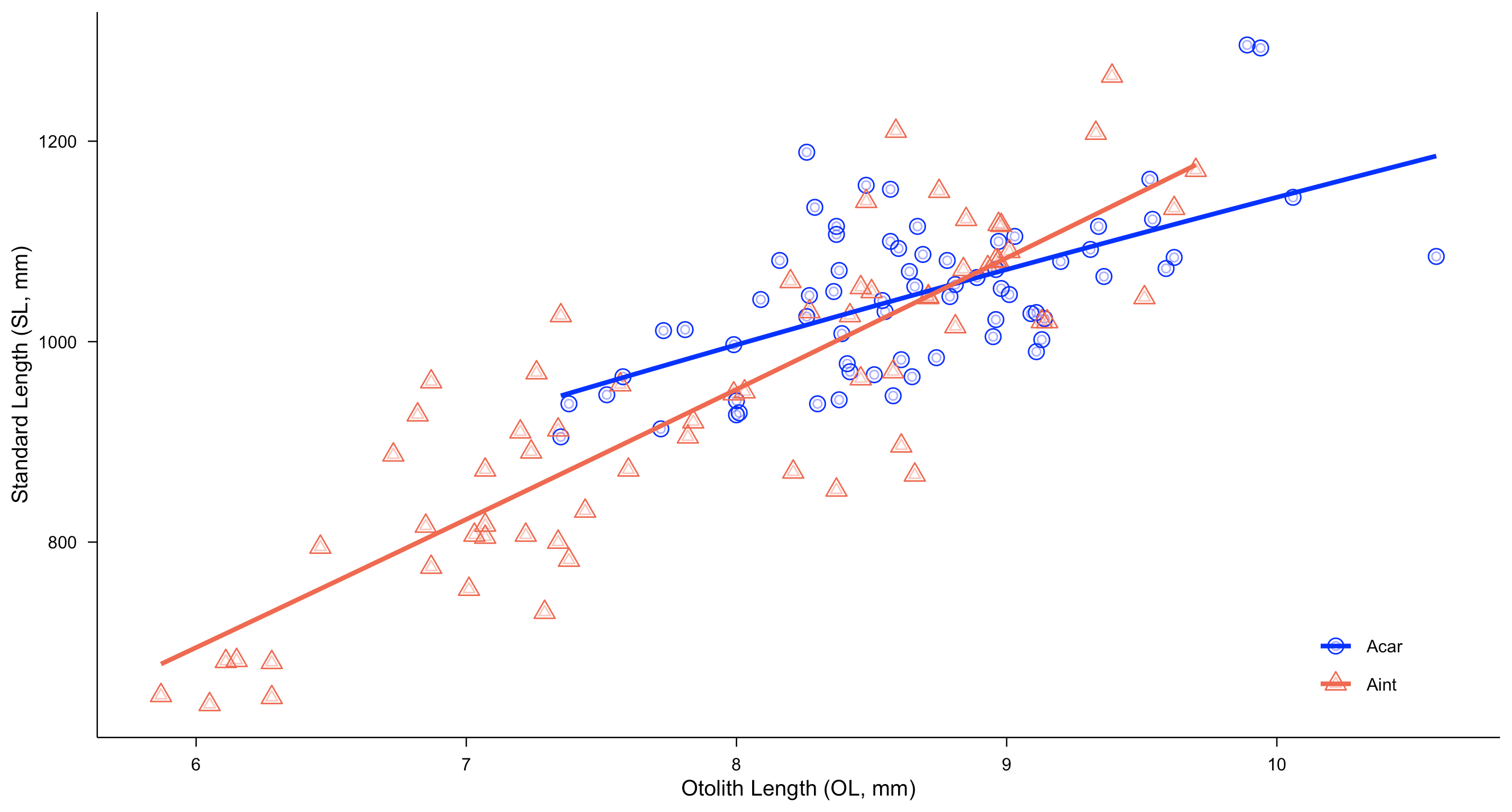
Linear models must not be used. Only power models Y=aXb has biologically meaningful (Lleonart et al., 1993). Parameter estimation can be performed using log-linear or non-linear regression (NLS). Example with NLS (Giménez et al., 2016; Tuset et al., in press).
# Using the built-in Aphanopus dataset
library(aforoR)
data(Aphanopus)

fit_allometric_Species <- Aphanopus %>%
  group_by(Species) %>%
  do({
    # Fit the allometric model: fish length = a * OL^b. SL = standard length
    fit <- tryCatch({
      nls_model <- nls(SL ~ a * OL^b, data = ., start = list(a = 10, b = 0.1))# start points must be checked.
      # Return the fitted model as a tibble
      tibble(Species = unique(.$Species), a = coef(nls_model)["a"], b = coef(nls_model)["b"], success = TRUE)}, error = function(e) {
      # If fitting fails, return NA for parameters and FALSE for success
      tibble(Species = unique(.$Species), a = NA, b = NA, success = FALSE)
    })
    fit
  })
fit_allometric_Species
right_fits <- fit_allometric_Species %>%
  filter(success == TRUE)

  # Fit the null model (SL = a) for each species (group)
fit_null_Species <- Aphanopus %>%
  group_by(Species) %>%
  do({
    # Try to fit the null model: SL = a (just the mean of SL)
    fit <- tryCatch({
      # Estimate the mean of SL for each group as the intercept
      a <- mean(.$SL, na.rm = TRUE)
      # Return the estimate as a tibble
      tibble(Species = unique(.$Species), a = a, success = TRUE)
    }, error = function(e) {
      # If fitting fails, return NA for a and success = FALSE
      tibble(Species = unique(.$Species), a = NA, success = FALSE)
    })
    fit
  })

# View the results of the null model fitting
fit_null_Species
right_fits_null <- fit_null_Species %>%
  filter(success == TRUE)

# Assuming that 'model' is the correct name of the column in fit_allometric_Species
deviance_results <- fit_allometric_Species %>%
  left_join(fit_null_Species, by = "Species") %>%
  mutate(
  # Calculate the residuals for the allometric model: SL - (a * OL^b)
    deviance_model = sapply(Species, function(species) {
      # Get the values of a and b for the current species
      species_data <- Aphanopus %>% filter(Species == species)
      a_value <- first(filter(fit_allometric_Species, Species == species)$a)
      b_value <- first(filter(fit_allometric_Species, Species == species)$b)
      sum((species_data$SL - (a_value * species_data$OL^b_value))^2, na.rm = TRUE)
    }),

    # Calculate the residuals for the null model: SL - a (from the null model)
    deviance_null = sapply(Species, function(species) {
      # Get the value of a for the current species from the null model
      species_data <- Aphanopus %>% filter(Species == species)
      a_value <- first(filter(fit_null_Species, Species == species)$a)
      sum((species_data$SL - a_value)^2, na.rm = TRUE)
    }),

    # Calculate the percentage deviance improvement
    percentage_deviance = ifelse(
      !is.na(deviance_model) & !is.na(deviance_null) & deviance_null != 0,
      ((deviance_null - deviance_model) / deviance_null) * 100,
      NA_real_
    )
  ) %>%
  ungroup()

  #View the results

  Species   a.x     b success.x   a.y success.y deviance_model deviance_null percentage_deviance
  <fct>   <dbl> <dbl> <lgl>     <dbl> <lgl>              <dbl>         <dbl>               <dbl>
1 Acar    276.  0.617 TRUE      1047. TRUE             276903.       430754.                35.7
2 Aint     97.5 1.10  TRUE       942. TRUE             376129.      1505230.                75.0
Allometric parameters (a.x and
b): a= 276.0 and b= 0.617 for
A. carbo and a= 97.5 and b= 1.10 for A.
intermedius.
Success of model fitting (success.x,
success.y). Both species show
TRUE for convergence, indicating that the non-linear
models fitted successfully and the parameter estimates are statistically
reliable.
Percentage deviance explained (a metric analogous of the coefficient of determination, R2): 35.7% for A. carbo, and 75.0% for A. intermedius. These results indicate that the otolith–fish allometric relationship is considerably more consistent and predictable in A. intermedius than in A. carbo.
2. Relative Otolith Indices
Otolith measurements can be used to compute relative otolith indices, which are related to life-history strategies in fishes (Cruz and Lombarte, 2004; Lombate and Cruz, 2007; Tuset et al., 2026, in press). There are two indices:
- Otolith relative length (ORL)= otolith length*100/fish length,
- Otolith relative size (ORS)= otolith area*1000/(fish length3).
Example illustrating how to asses growth rate variation between otolith and fish.
library(ggplot2)
ggplot(Aphanopus, aes(x = SL, y = (OL*100)/SL, color = Species, shape = Species)) +
  geom_point(size = 3) +
  scale_shape_manual(values = c(1,2)) +
  scale_color_manual(values = c("blue","coral2")) +
  geom_smooth(aes(color = Species),
              method = "lm",
              formula = y ~ x,
              se = FALSE,
              size = 1) +
  labs(
    y = "Relative otolith length (ROL)",
    x = "Standard Length (SL, mm)",
    color = "Species"
  ) +
  theme_minimal() +
  theme(
    legend.title = element_blank(),
    legend.text = element_text(size = 8),
    plot.title = element_text(size = 12, face = "bold", hjust = 0.5),
    axis.title = element_text(size = 10),
    axis.text = element_text(size = 8, color = "black"),
    panel.grid.minor = element_blank(),
    panel.grid.major = element_blank(),
    axis.line = element_line(color = "black", linewidth = 0.3),
    axis.ticks = element_line(color = "black", linewidth = 0.3),
    axis.ticks.length = unit(0.15, "cm")
  )
#code is similar to ROS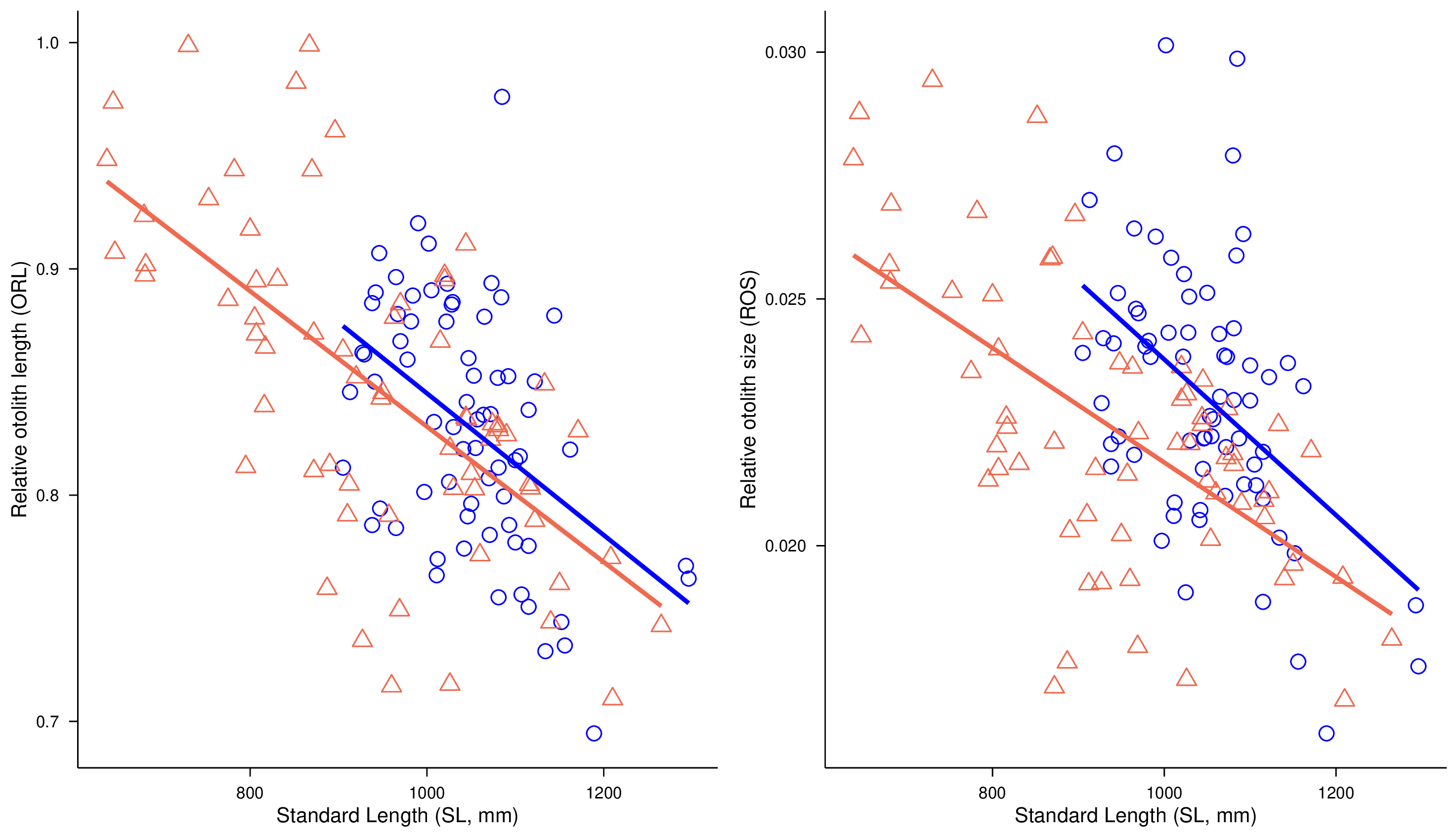
ROL shows no apparent interspecific differences relative to fish growth, whereas ROS is higher in A. carbo. This suggests that otoliths of A. carbo are generally wider, or otoliths of A. intermedius display greater irregularity. The first hypothesis is more plausible after examining PC1-PC2 plot.